
Two common options are UV inks and solvent inks. Both can produce durable, attractive results, but they work differently. Those differences can affect volatile organic compound (VOC) emissions, production efficiency, durability, and the overall environmental impact of a packaging project.
Understanding UV vs. solvent inks can help brands make better choices based on both performance needs and sustainability goals.
UV inks are specially formulated inks that cure when exposed to ultraviolet light. Instead of drying mainly through evaporation, the ink changes from a liquid to a solid when it passes under a UV curing system. 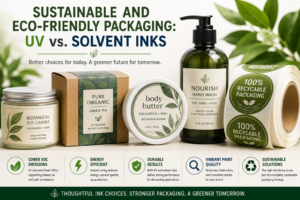
This process happens very quickly. Once cured, UV inks can create sharp graphics, strong colors, and durable printed surfaces.
UV printing can also work with a wide range of substrates, including many films, plastics, papers, and other materials used for labels and packaging.
From a sustainability perspective, one major advantage is that UV inks generally release fewer VOCs during curing than traditional solvent-based inks. Because the ink cures rather than relying heavily on solvent evaporation, more of the ink remains on the printed surface.
Solvent inks use a liquid carrier to transfer pigments to a substrate. During drying, much of the solvent evaporates and leaves the printed image behind.
These inks have long been used for applications that require strong adhesion and durability. Depending on the formulation and material, solvent inks can perform well in demanding environments.
However, traditional solvent-based printing may release VOCs as the ink dries. Manufacturers may need ventilation, emissions controls, or other production systems to manage these compounds.
Modern ink technologies continue to improve, so the environmental impact can vary significantly by ink formulation, printing process, equipment, and application.
When comparing inks for sustainable and eco-friendly packaging, it helps to look beyond a single environmental claim. Packaging needs to perform properly throughout its intended life.
 Here are several important differences.
Traditional solvent inks can produce VOC emissions as solvents evaporate during drying.
UV inks typically have very low solvent content and cure through exposure to UV energy. This can help reduce VOC emissions associated with the printing process.
For companies focused on reducing emissions from printing operations, this can make UV technology an option worth evaluating.
UV inks cure almost immediately. Printed materials can often move to the next production stage without a long drying period.
Solvent inks require time and suitable conditions for evaporation and drying. Depending on the process, that can affect production speed.
Faster curing can improve workflow efficiency and reduce the space needed for drying or staging printed materials.
Packaging has to communicate information clearly while supporting a consistent brand appearance.
UV printing can deliver crisp text, fine details, and vibrant graphics. This is valuable for packaging and labels containing small type, logos, barcodes, instructions, or detailed product graphics.
Solvent inks can also provide strong print quality. The best choice depends on the substrate, design, printing method, and performance requirements.
Sustainability does not automatically mean using the material or process with the lowest initial environmental impact. A label that fails too early may need to be replaced, which creates additional material use and waste.
UV inks can provide strong resistance to scratching, moisture, chemicals, and general handling when paired with the right substrate and printing process.
Solvent inks are also known for durability and adhesion in many demanding applications.
For either option, testing should reflect the conditions the finished package or label will actually experience.
Not necessarily.
UV printing offers clear potential benefits, including lower VOC emissions and fast curing. However, packaging sustainability depends on the complete system.
Brands should consider the ink, label material, adhesive, liner, packaging substrate, manufacturing process, transportation requirements, expected product life, and end-of-life options.
For example, choosing a lower-emission ink does not automatically make a package recyclable. Ink and material compatibility may also affect recycling or recovery processes.
That is why sustainable packaging decisions should consider the complete application rather than focusing on one component.
Before selecting UV or solvent inks, consider a few practical questions:
Answering these questions can help narrow down the right combination of ink, material, adhesive, and printing process.
UV inks can support more sustainable printing strategies because they generally produce fewer VOC emissions than traditional solvent-based inks. However, the environmental impact of the complete packaging system should also be considered.
Yes. Solvent inks remain useful for applications requiring strong adhesion, outdoor performance, or durability on certain materials. The right ink depends on the application and substrate.
Both UV and solvent inks can produce durable labels. Performance depends on the ink formulation, substrate, adhesive, protective coatings, and conditions the label will face.
Ink is only one part of the equation. Sustainable packaging may also involve material selection, reduced waste, efficient manufacturing, recyclability, durability, and responsible end-of-life planning.
Choosing between UV and solvent inks requires balancing environmental goals with print quality, durability, materials, and real-world performance. UV inks can offer advantages such as lower VOC emissions and fast curing, while solvent inks remain valuable for specific substrates and demanding applications.
For brands exploring sustainable and eco-friendly packaging, the best approach is to evaluate the entire package rather than focusing on ink alone.
Contact Label Haus to discuss sustainable label and packaging options that balance appearance, durability, performance, and environmental goals.